

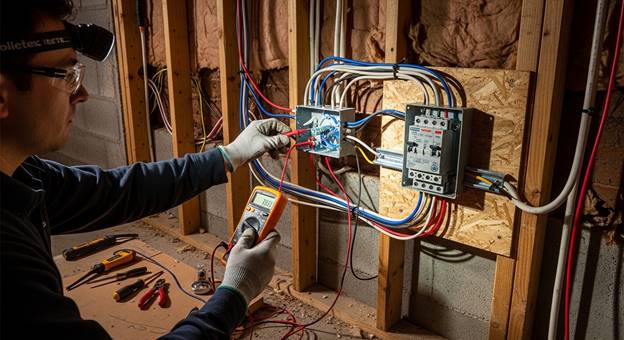
If you’re planning to wire or remodel your basement in Kent County or Sussex County, Delaware, one of the most common questions homeowners ask is:
Do I need a permit for basement wiring?
if you’re planning professional basement wiring in Kent and Sussex County, one of the most common questions homeowners ask is:
In most cases, the answer is yes — especially if you are adding new circuits, installing a subpanel, finishing the basement, or modifying existing wiring.
Skipping permits or hiring an unlicensed electrician can lead to failed inspections, unsafe wiring, and costly corrections.
Here’s what homeowners and contractors need to know.
When Is a Permit Required for Basement Wiring in Delaware?
A permit is typically required when:
- Adding new electrical circuits
• Installing a basement subpanel
• Finishing a basement
• Adding a bathroom in the basement
• Installing new lighting circuits
• Modifying or expanding existing wiring
Projects inside city limits may also require a city business license for the contractor performing the work.
Always verify that your electrician holds a valid electrical license and required local credentials.
Never hire a contractor who cannot provide proof of electrical licensing.
Common Reasons Basement Wiring Fails Inspection
Over the years, we’ve seen basement inspections fail in Kent and Sussex County for the following reasons:
- Missing arc-fault protection
• Missing GFCI protection
• No dedicated circuit for sump pumps
• No dedicated circuit for ejector pumps
• Bathroom receptacle installed on a 15-amp circuit instead of a required 20-amp circuit
• Wiring installed too close to the edge of framing lumber
• Missing recessed lighting brackets
• No required smoke detectors
• Missing carbon monoxide detectors
Many of these issues occur when wiring is installed without proper planning or code knowledge.
Correcting failed inspections often costs more than doing it properly the first time.
Arc-Fault & GFCI Protection Requirements
Modern electrical code requires arc-fault and ground-fault protection in many basement areas.
Lighting circuits often require dual-function breakers that provide both arc-fault and GFCI protection.
Receptacle circuits typically require 15-amp or 20-amp dual-function protection depending on the layout and use.
Installing the wrong breaker type is one of the most common reasons inspections fail.
Dedicated Circuits Are Critical in Basements
Basements commonly power:
- Sump pumps
• Ejector pumps
• Electrical fireplaces
• Mini refrigerators
• Microwaves
• Bathroom pumps
• Bathroom receptacles
• Home theater equipment
Each room or functional area should have its own dedicated circuit to prevent overload.
Sharing circuits improperly can cause nuisance breaker trips and increase fire risk.
A properly planned basement electrical layout reduces long-term problems.
Panel Evaluation Before Basement Wiring
Every basement project should begin with a panel evaluation.
Many homes in Dover, Smyrna, Milford and surrounding areas: require a panel upgrade before adding new circuits…
- Do not have enough breaker space
• Have older panels not designed for modern loads
• Require a panel upgrade
• Require a subpanel installation
Skipping panel evaluation can lead to overloaded systems and failed inspections.
Professional electricians assess breaker capacity, load demand, and grounding before adding circuits.
Bathroom Electrical Requirements in Basements
Basement bathrooms have strict electrical code requirements.
Common mistakes include:
- Installing receptacles on 15-amp circuits
• Not using required GFCI protection
• Not installing proper ventilation wiring
• Sharing circuits improperly
Bathroom receptacles typically require a dedicated 20-amp circuit to pass inspection.
Smoke & Carbon Monoxide Detector Requirements
Finishing or modifying a basement often triggers smoke and carbon monoxide detector requirements.
These safety devices must be installed according to code and properly interconnected where required.
Failure to install them correctly is another common inspection issue.
Why Hiring a Licensed Electrician Matters
Electrical permits, inspections, and code compliance are not optional.
In Delaware, electrical work must be performed by a licensed electrician.
If work is performed inside city limits, a valid city business license may also be required.
Before hiring any contractor, always ask for:
- Proof of electrical license
• Proof of insurance
• Confirmation that permits will be pulled
Hiring an unlicensed contractor may save money upfront but can create serious legal and safety risks.
Experiencing electrical issues? Get expert electrical repairs done right the first time.
Protect Your Investment
Your basement is an extension of your home.
Proper electrical wiring protects:
- Your family’s safety
• Your property value
• Your insurance coverage
• Your future resale
If you are planning basement wiring in Kent or Sussex County, make sure it is done correctly, inspected properly, and installed to code.
Need Professional Basement Wiring in Kent or Sussex County?
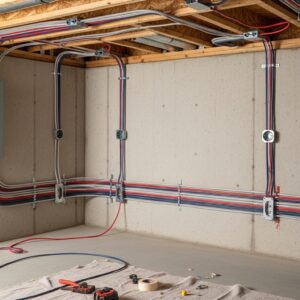
LR Electrical LLC provides licensed, code-compliant basement wiring services for homeowners and contractors throughout Kent and Sussex County, Delaware.
From panel evaluation to permit-ready installations, we ensure your project is safe and inspection-ready.
Contact us to schedule a professional basement wiring evaluation.